UNITED COMMUNITIES CORP. (UCC)

Flyers, Brochures & Posters: Text Versions

This page contains readable text versions of the printed materials available at UCC’s outreach tables.

It includes information from our flyers, brochures, palm cards, and posters, with explanations of important pictures and diagrams.

You can read the information here or use your preferred screen reader or reading tool.

The materials appear below in the order listed. Each has its own heading. You can read down the page or use your screen reader’s heading navigation to move between sections.

We update this page as we add materials and receive feedback.

Materials Included

  • UCC Trifold and Palm Card: Text Version
  • Understanding Opioids and Naloxone: Text Versions
  • Massachusetts Good Samaritan Law: The 3 Ws

UCC Trifold and Palm Card: Text Version

United Communities Corp. (UCC)

Mobile Multiservice Resource Hub

Meeting people where and when they feel safe and ready to connect.

This text version provides the shared information from our printed trifold brochure and palm card. Information about the back of the trifold brochure appears at the bottom.

Looking for Support?

Not sure where to start? You’re not alone. See how UCC can help.

We are the connectors adapting to your needs. Whether we help you directly or connect you to someone who can, you’re not alone.

You decide how much we’re a part of your journey.

We provide support and connect people, families, and organizations to what they say they need most.

Our Mission

“To close the gap between people and the services they need to access.”

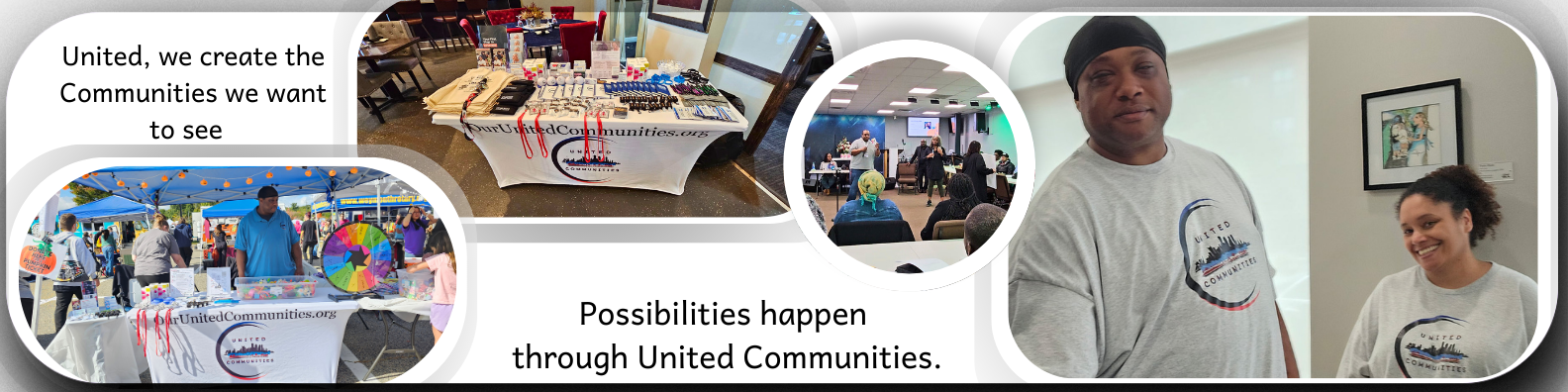
United, we create the communities we want to see. Possibilities happen through United Communities.

Communities We Serve

Based in Weymouth, Massachusetts.

Serving the South Shore, Greater Boston, and communities across Massachusetts through collaborative partnerships.

Contact Us

Call: Call UCC at 617-302-6175

Text: Send a text to UCC at 617-302-6175

Hours: Monday through Sunday, 11:00 a.m. to 7:00 p.m.

You can leave a message 24 hours a day, seven days a week.

Leaving a detailed message helps us understand your needs and return your call with resources. Share only what you feel comfortable sharing.

Email: info@ourunitedcommunities.org

Some of What We Do or Connect You With

Basic Needs

  • Clothing: Clothing from UCC or connections to local clothing drives.
  • Food: Help connecting with food pantries and meal programs.
  • Housing: We cannot provide housing directly, but we walk with you to find the next step.
  • Bills: Connections to programs that support rent, heat, or utilities.

Health and Safety

  • Forms and paperwork: Sitting with you to complete forms.
  • Health care: Connections to doctors and clinics.
  • Harm reduction: Free naloxone, also known as Narcan, overdose prevention education, and safety training.
  • Stress: Caring support for emotional wellness.

Inclusion and Accessibility

Support navigating school services, Individualized Education Programs (IEPs), and disability services.

Tell us about any communication or accessibility needs you would like us to consider.

Notary Public

Help with notarizing documents when needed. Contact us about availability.

Language Access

  • Portuguese: Falamos português.
  • Spanish: Hablamos español.
  • French: On parle français.
  • Cape Verdean Creole: Nú ta papia kriolu.
  • American Sign Language (ASL): Support available.

Tell us which language and communication format work best for you so we can discuss available support.

For Organizations and Nonprofits

Consulting on translation, culturally grounded materials, program design, creative content development, and more, including logos and visuals.

Contact us to discuss your goals, the scope of the work, and any applicable fees.

Free Naloxone and Training

We provide free naloxone, also known as Narcan, and training.

Ask us how to get naloxone or where to find it near you.

Call or text 617-302-6175. Tell us if you need instructions in a particular language or accessible format.

The Back of Our Brochure

The back highlights our programs and services, along with activities and illustrations about community support and harm reduction.

Bringing Support Directly to People

Meeting people where and when they feel safe and ready to connect with us.

Our work includes:

  • Community programs.
  • Accessibility.
  • Continuing support.
  • Harm reduction.
  • Family connections.
  • Resource connections.
  • Athletic programs.

Some of Our Services

  • Life coaching and peer support.
  • Multicultural and community connections.
  • Education and youth leadership.
  • Notary services.
  • Expressive arts and athletic programs.
  • Naloxone and overdose prevention education.
  • Resource navigation and connections.

We do so much more!

Activities and Illustrations

The back includes harm reduction coloring artwork and a word search featuring community needs and services.

It also includes a maze illustrating how complicated finding support can feel. One person asks, “How do I figure this out?”

Another part of the illustration shows people moving forward together with UCC’s support. Its message is that UCC can walk alongside you as you navigate services and work toward your goals.

Start With Us

We’ll listen, support, and connect you.

United, you’re never alone. Let us be your community. Together, we are United Communities.

Understanding Opioids and Naloxone: Text Versions

Information from UCC’s printed educational materials, with explanations of the diagrams and additional information about naloxone and Narcan.

What Are Opioids?

Opioids are a group of drugs that act on opioid receptors in the brain and body. They include prescription medicines and drugs such as heroin.

Prescription opioids are mainly used to treat moderate to severe pain. Some are also used to treat coughing or diarrhea.

Examples of Opioids

  • Hydrocodone, found in medicines such as Vicodin.
  • Oxycodone, found in medicines such as OxyContin and Percocet.
  • Oxymorphone.
  • Morphine.
  • Codeine, including some prescription cough medicines and medicines that combine acetaminophen with codeine.
  • Fentanyl.
  • Heroin.

Fentanyl is used medically for certain types of severe pain and during medical procedures. It is also made illegally and may be present in other drugs or counterfeit pills without the person knowing.

You cannot tell whether a pill contains fentanyl by looking at it.

Opioids can slow breathing. An opioid overdose can cause breathing to slow dangerously or stop.

What Is Naloxone? What Is Narcan?

Naloxone is a medicine that can temporarily reverse an opioid overdose and help restore breathing.

Narcan is one brand name for naloxone. Generic naloxone and other brands are also available.

Naloxone comes in different forms, including nasal spray and injection. Follow the instructions for the specific product you have.

Naloxone treats an opioid overdose. It is not a treatment for a stuffy nose.

Naloxone does not replace emergency medical care. A person needs emergency help even if they improve after receiving it.

How Does Naloxone Work?

What Are Receptors?

Receptors are parts of cells that respond to particular chemical signals. Opioid receptors are found in the brain, spinal cord, and other parts of the body.

One type is called a mu opioid receptor. “Mu” is pronounced like “mew.”

The body makes its own opioid-like chemicals. These chemicals and opioid medicines can attach to opioid receptors.

A Simple Comparison: Locks and Keys

Think of a receptor as a lock. Certain chemicals act like keys that fit into that lock.

When opioids attach to these receptors, they can reduce pain. They can also cause sleepiness and slow breathing.

During an opioid overdose, their effects can suppress breathing so severely that the person is not getting enough oxygen.

How Naloxone Helps

Naloxone attaches to opioid receptors and can displace opioids already attached to them. It blocks their effects temporarily and can help restore breathing.

Naloxone can wear off before the opioid does. Breathing problems can return, and additional doses may be needed.

What the Receptor Flyer’s Diagram Shows

The flyer uses receptor shapes, colored circles, and people to explain the process visually. Its main message is:

  1. Opioids attach to receptors and can reduce pain.
  2. Too much opioid effect can slow or stop breathing.
  3. Naloxone blocks opioid effects at the receptors and can help the person breathe again.

The diagram is a simplified explanation. You do not need to see the shapes or colors to understand its message.

Who Is Naloxone For?

Naloxone is for anyone experiencing a suspected opioid overdose.

It is not only for people who regularly use drugs. An opioid overdose can happen after an accidental exposure, a medication mistake, or taking something containing an unexpected opioid.

The flyer gives these examples of situations in which an opioid overdose could occur:

  • Your toddler swallowed an opioid pill you accidentally dropped.
  • Your child mistook an opioid medicine for candy.
  • Your teenager experimented with a pill containing an opioid.
  • Your friend took something containing an unexpected opioid.
  • A tired parent accidentally mixed an opioid with other medicines.
  • A veteran trying to quiet nightmares took something containing an opioid.
  • Your grandparent accidentally took an extra opioid dose.
  • A stranger beside you is experiencing a suspected opioid overdose.

These examples do not mean that every exposure causes an overdose. They show why people of different ages and backgrounds may need access to naloxone.

Be Prepared. Save a Life.

You don’t carry a bandage because you’re bleeding. You carry it just in case. Carry naloxone for the same reason.

Carry it. Learn to use it.

Naloxone can save someone experiencing an opioid overdose. Every life matters.

If You Suspect an Opioid Overdose

Give naloxone if available and call 911 immediately.

Follow the product instructions and the emergency dispatcher’s directions.

Stay with the person until emergency help arrives. They still need medical attention even if they wake up.

Get Naloxone and Training From UCC

UCC provides free naloxone and training. Ask us how to get naloxone or where to find it near you.

Tell us if you need information or training in a particular language or accessible format.

Call UCC at 617-302-6175

Send a text to UCC at 617-302-6175

Email UCC at info@ourunitedcommunities.org

Massachusetts Good Samaritan Law: The 3 Ws

This is a text version of UCC’s printed Good Samaritan Law flyer, with clarifications about the law’s protections and limits.

Seeking Help During an Overdose

Massachusetts law provides certain protections for the person experiencing a drug-related overdose and anyone who seeks emergency medical assistance for them in good faith.

“In good faith” means genuinely seeking emergency medical assistance.

If you suspect an overdose, call 911 immediately.

What Does the Law Protect?

Under Massachusetts General Laws, Chapter 94C, Section 34A, protections include:

  • Protection from charges or prosecution for simple drug possession when the evidence is obtained because medical assistance was sought, under the conditions specified in the law.
  • Protection against certain probation, pretrial release, or parole violations when the evidence comes from the overdose or the request for medical help, under the conditions specified in the law.

These protections apply to the person seeking help and the person experiencing the overdose when the law’s conditions are met.

They do not provide protection from every possible offense.

The 3 Ws: Warrants, Weapons, and Weight

The 3 Ws are a reminder of important limits. They are not the law’s official wording.

1. Warrants

An open or existing arrest warrant is not canceled by seeking overdose assistance.

A person may still be arrested on an outstanding warrant.

2. Weapons

The overdose law does not provide protection from weapons charges.

Carrying a weapon is not automatically an offense. Whether it is illegal depends on the circumstances and applicable law.

3. Weight

“Weight” refers to the amount of a controlled substance, which can matter in a drug-trafficking case.

The Good Samaritan Law does not prevent charges for trafficking, distribution, or possession of a controlled substance with intent to distribute.

Drug quantity is not the only consideration in every case.

Giving Naloxone

Massachusetts law also protects people who administer naloxone, also known as Narcan, in good faith to someone appearing to experience an opioid overdose.

Chapter 94C, Section 19B provides protections from criminal or civil liability and professional disciplinary action arising from good-faith administration of an opioid overdose reversal medicine.

What This Means

The law offers important protections when people seek medical help during an overdose.

It does not provide protection from every possible charge or guarantee that no arrest will occur.

An overdose is a medical emergency. Call 911 and seek help immediately.

This site is a living system — it grows and changes with community needs.

If something feels unclear, inaccessible, or missing, your feedback helps shape what comes next.

Email us anytime at info@ourunitedcommunities.org or tap on the “Help us improve this page”  button 

Quick Exit
UNITED COMMUNITIES CORP.

How can we help?

Leaves Help Now quickly. To return, completely close the UCC page and reopen it.

Choose what you need right now.

Privacy & safety

Quick Exit hides this pop-up and replaces the floating buttons with hearts. It does not erase browser history or hide activity from someone monitoring your device.

Leaves Help Now quickly. To return, completely close the UCC page and reopen it.