Websites and digital experiences
Clear navigation, accessible content, useful pathways, and digital experiences designed around the people using them.
United Communities Corp.
Building Stronger Organizations. Building Stronger Communities.
Every organization has its own mission, priorities, communities, funding structures, regulations, partnerships, staffing realities, and long term goals. We help bring those moving parts together into practical strategies that fit your organization and the people you serve.
The Psychology Behind Our Approach
Every flyer, website, intake form, conversation, classroom activity, and outreach event influences how people decide whether to engage.
Those decisions are shaped by trust, emotion, identity, past experiences, culture, accessibility, social expectations, and how people experience an organization from the first point of contact forward.
Our approach draws on principles from behavioral psychology, social psychology, community psychology, behavioral science, sociology, and public health. Rather than relying on assumptions, we help organizations design communication, services, systems, and experiences that reflect how people actually think, feel, learn, decide, and participate.
We translate those principles into practical changes an organization can use, including clearer communication, stronger outreach, more accessible systems, better participant experiences, and engagement strategies built around real human behavior.
Our consulting is guided by a multidisciplinary framework. Explore how UCC brings psychology, public health, sociology, systems thinking, accessibility, community knowledge, creativity, and lived experience together.
Explore Our FrameworkQuestions We Help Explore
Our Approach
Every organization brings expertise. Every community brings knowledge. Every person brings lived experience. When those come together, organizations are better positioned to build services that are accessible, trusted, responsive, and sustainable.
Before offering recommendations, we take time to understand your mission, your priorities, the communities you serve, and the strengths that already exist inside your organization.
We begin with strengths, not deficits. We do not separate a program from the people carrying it because design, staffing, communication, and sustainability affect one another.
Your expertise is not something we replace. Our role is to bring another perspective, strengthen connections, and help develop strategies that reflect your priorities and your community's realities.
Understanding Culture
Culture is the collection of experiences, values, relationships, identities, environments, traditions, and systems that influence how people communicate, build trust, seek support, solve problems, learn, and participate.
Select, tap, or click each oval to explore how UCC views culture.
Each connection adds another part of the whole. Select an oval to explore.
How We Look at the Whole
A flyer that is not working, a training that did not change practice, and a community that does not return calls may be connected. We look at how the parts influence one another.
Click the plus sign beside each area to learn more about how we approach that part of organizational work.
We look at how a program is experienced from the outside in. We examine how someone first hears about it, what they must do to access it, what they are asked to give up to qualify, and where the process quietly loses people. We also consider who carries the work internally and whether the design is sustainable for the people delivering it.
We design more than materials. We design how people experience information, services, and organizations. Websites, presentations, educational resources, communication campaigns, workflows, frameworks, and participant materials are guided by accessibility, psychology, visual hierarchy, literacy, and usability.
Our lived experiences and professional backgrounds give us firsthand insight into multiple languages and cultures, but our work is not limited to them. We approach every community with curiosity, humility, and a commitment to understanding its unique context. Our multilingual capabilities include Portuguese, Spanish, French, Cabo Verdean Creole, ASL, and English.
Translation is an important first step, but understanding requires more than words. We consider regional differences, local expressions, dialects, generational influences, cultural context, communication styles, and the way people naturally speak and understand information.
Every training is built for the organization receiving it. We begin with the real situations staff encounter, the strengths they already bring, and the goals they want to achieve. We then design learning experiences that reflect the organization, its work, and the communities it serves.
Engagement grows through trust, consistency, and shared experience. We examine how an organization is already positioned in a community, who holds those relationships, and what would make participation feel genuinely possible rather than merely invited.
Some conversations need more than a meeting. They need trust. We create environments where people feel heard, respected, and able to participate during listening sessions, planning conversations, coalition discussions, community forums, and conversations intended to address challenges or strengthen relationships.
Creativity is one of the ways we solve problems. We design interactive activities, exhibits, educational games, presentations, visual displays, booths, storytelling experiences, printed materials, and engagement strategies that encourage people to participate, learn, connect, and take action.
Creative Strategy in Practice
The purpose is not decoration. The purpose is to make information easier to understand, systems easier to navigate, and experiences more meaningful.
Clear navigation, accessible content, useful pathways, and digital experiences designed around the people using them.
Visual communication that supports understanding, participation, memory, and real world application.
Games, activities, stories, and self directed learning designed to invite curiosity and participation.
Resources shaped by literacy, language, visual hierarchy, accessibility, and the context in which they will be used.
Processes that help staff understand what happens, who carries each step, and where people may become disconnected.
Booths, exhibits, public education, and interactive spaces designed to help people connect, learn, and take action.
What This Looks Like in Practice
A community organization hired us because its experienced outreach team and strong evidence based harm reduction services were having difficulty connecting with one particular community.
We explored cultural considerations, communication approaches, community relationships, and the conditions that shape trust and engagement.
We joined the outreach team on a community outreach walk so we could observe how people interacted, communicated, and responded in that environment.
Building on the organization's strengths, we helped expand opportunities to distribute harm reduction supplies and connect more people with existing services.
Nothing about their program was wrong. What changed was how it reached people.
How We Work With You
You tell us about the opportunity, concern, idea, or goal you want to explore.
We learn about your organization, strengths, communities, context, and priorities.
Deliverables, timeline, responsibilities, and cost are agreed to in writing.
We work with you to create practical strategies, tools, systems, or experiences you can use.
Some organizations hire us for one training or a defined project. Others retain us as the work develops. Sliding scale may be available for grassroots, multicultural, multigenerational, community based, and limited resource organizations.
Training and Community Learning in Practice
Organizations may bring UCC in for a single training, presentation, event, or customized learning experience. We shape each engagement around the audience, community, culture, generation, and goals of the organization.
We provide practical naloxone education and overdose prevention training designed to help people recognize an overdose, respond, use naloxone, and connect with additional resources.
We create respectful learning experiences that reduce stigma surrounding mental health and substance use while recognizing that culture, family, language, age, and generation can shape how these topics are understood.
Create & Learn uses expressive arts, storytelling, and interactive learning to open conversations, strengthen understanding, and help participants engage with topics that may otherwise feel difficult to discuss.
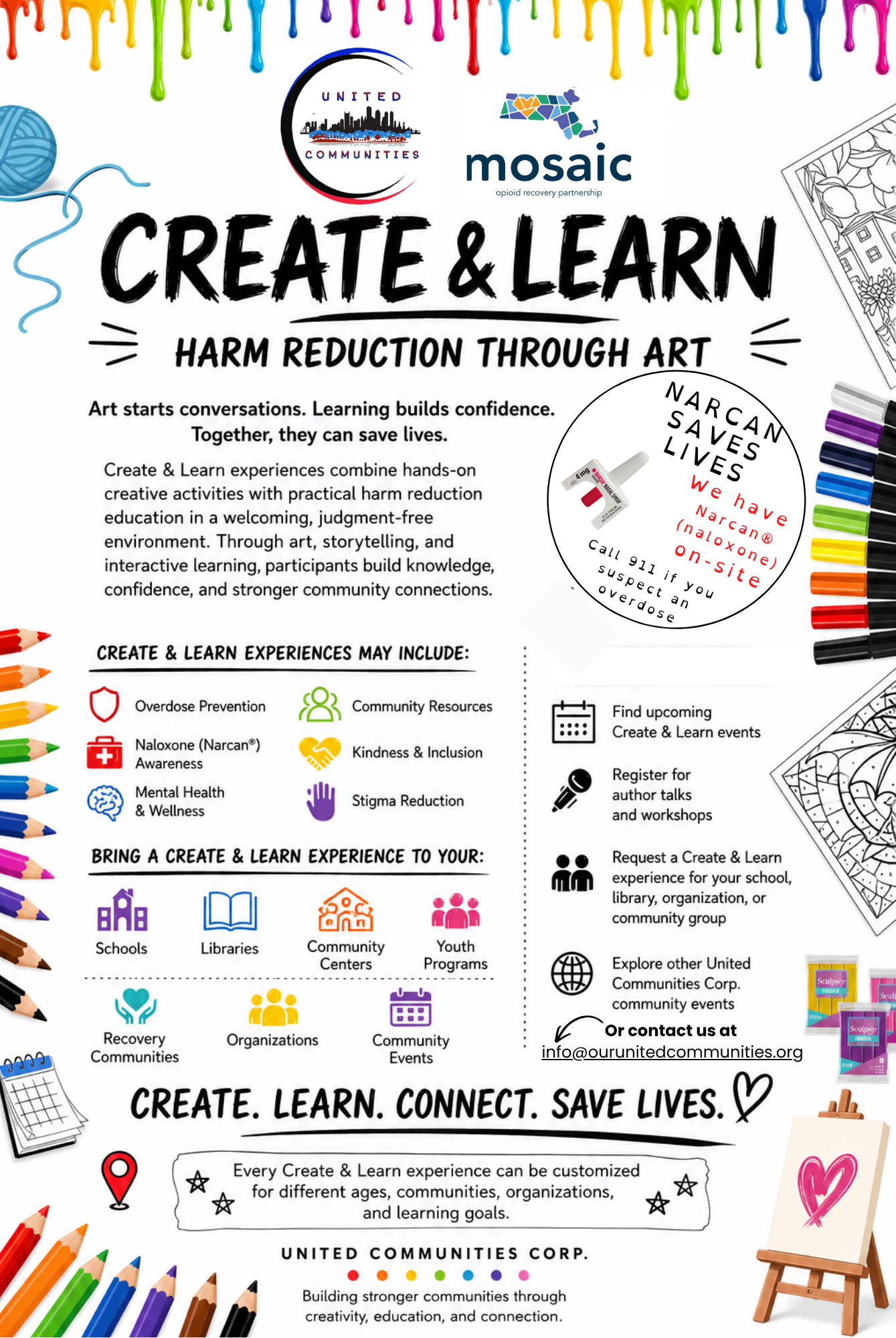
An Example of Our Work
This community learning experience combines hands-on creative activities with practical harm reduction education in a welcoming, judgment-free environment.
It is one example of how UCC brings together expressive arts, overdose prevention, mental health and wellness, stigma reduction, community resources, kindness, and inclusion. Experiences can be customized for different ages, organizations, communities, cultures, and learning goals.
Why Organizations Hire Us
Our recommendations come from community based practice, multilingual communication, lived experience, and years of working alongside individuals, families, organizations, and communities.
We recognize how people, programs, communication, systems, and communities affect one another in ways that are difficult to see from inside daily operations.
We enter with curiosity and the understanding that you are the expert in your own work. We are responsible for delivering something useful, not for grading your organization.
Your Consulting Team
UCC's consulting is led by professionals whose education, certifications, creative practice, leadership, and direct community experience shape how we understand organizations and help turn strategy into action.
Founder and Chief Executive Officer
Community Engagement Leader • Harm Reduction Specialist • Partnership and Implementation Strategist
David brings extensive hands-on experience in community outreach, relationship building, harm reduction, recovery support, overdose prevention, organizational leadership, and partnership development. He helps organizations connect strategy to implementation and understand what engagement looks like in the places where people live, gather, work, and seek support.
David helps organizations build trusted relationships, strengthen partnerships, and move plans from paper into community-based action.
Co-Founder and President
Behavioral Strategist • Community Engagement Specialist • Creative Strategist
Paloma combines psychology, sociology, public health, accessibility, multilingual communication, community practice, educational advocacy, art, and lived experience to help organizations understand why people engage, disengage, trust, hesitate, or walk away. She translates behavioral and social insights into practical communication, programs, systems, training, visual tools, and participant experiences.
Paloma helps organizations connect human behavior, community realities, communication, creativity, and systems so services are easier to understand, more accessible, and more likely to earn participation and trust.
Our work does not come from one discipline or one type of experience. Together, we bring psychology, sociology, behavioral science, public health, educational advocacy, creative practice, organizational leadership, community outreach, recovery knowledge, language access, systems thinking, and direct practice into the same conversation.
Your Investment Has Two Impacts
When organizations partner with United Communities Corp., they receive customized consulting, training, strategic support, and practical tools designed to strengthen their own work.
Because UCC is a nonprofit organization, revenue generated through consultation services also supports our ability to sustain community-based initiatives, education, outreach, language access, harm reduction, and other services that benefit individuals and families.
Your investment does not stop with one project. It helps strengthen your organization and extends into the communities we collectively serve.
Request UCC
This initial form helps our team understand your organization, your goals, and whether you are requesting consultation, training, a presentation, a customized experience, or UCC participation at an event. Submitting it does not commit you to services or a contract.
Every organization, community, and engagement is different. We will review your request and tell you honestly whether UCC appears to be the right fit.